

When it comes to protecting privacy in the world of cryptocurrency, choosing the right wallet matters just as much as choosing the right coin. Because privacy is still one of the main concerns for crypto users, and Monero is one of the leading privacy-focused cryptocurrencies designed to keep transactions anonymous and secure.
But it can only be fully preserved if you store your funds in a reliable and secure wallet, too. While there are many options available, selecting the best one that fulfills all needs is difficult, and to make your decision easier, in this article, we will explore the best Monero wallet available today, compare their features, security, and ease of use, so you can confidently choose the one that keeps your XMR safe.
What is Monero?
Monero XMR is one of the major privacy-focused and decentralized cryptocurrencies, where every user is anonymous by default. It was launched in 2014, and since then, it has enabled untraceable transactions unlike Bitcoin. There are three main advanced technologies, like Stealth Addresses, Ring Signatures, and Ring Confidential Transactions (RingCT), that keep the sender, receiver, and transaction hidden in Monero.
It is widely used by individuals who want financial privacy. As a decentralized network, Monero operates independently without any single government or financial institution that makes it resistant to centralized control and less vulnerable to restrictions like capital controls.
About Monero Wallet
A crypto wallet is a tool that lets you connect with a cryptographically protected blockchain. A crypto wallet stores private keys (cryptographic strings) to manage the wallet address. These private keys enable you to control and access funds connected with a specific blockchain address.
So, the Monero XMR wallet allows you to connect with the Monero blockchain. The wallet does not store Monero; however, your XMR coin remains on the Monero blockchain always. The main function of a wallet is to generate and securely store private keys that give you access to and control over your Monero accounts.
With any crypto wallet, you can store, manage, send, and receive crypto from other wallets across the blockchain. Most of the crypto wallets support multiple blockchains and allow you to exchange cryptocurrencies.
How Monero Works
Monero uses a blockchain network to record transactions. Most of the crypto blockchains are transparent, like Bitcoin BTC, and anyone can access them by using a block explorer. The real name is not recorded on the Bitcoin blockchain, wallet addresses, or transaction amounts. Although all bitcoin transactions can be traced.
However, Monero’s blockchain is public, and it uses 3 protected mechanisms to hide and keep your identity anonymous.

Ring Signatures
Monero protects your privacy on the input side of a transaction using ring signature technology. It covers the sender and the receiver of a transaction. You can assume it is a digital signature where a group of probable senders is bonded together to make a new signature that approves a transaction.
This signature is by the actual sender and numerous non-senders to create a ring. Here, the non-senders are traps that get from the past transactions on the blockchain. The probable senders are equal and legal, so the real sender remains anonymous.
To avoid spending more than one time, a key image is made for every ring signature transaction. Only one key image is made for every blockchain output, so miners can verify that no outputs are spent twice. This key image is protected by cryptography, so the actual sender in the ring signature made the key remain anonymous.
RingCT: Ring Confidential Transaction
RingCT was added in January 2017 to improve the ring signature system in Monero. It basically enhanced the privacy of the ring signature technology. When the RingCT was not implement Monero required transaction volumes to be divided into values to make sure there would always be enough non-senders to form a Ring Signature for that amount. However, the other people can see the transaction amounts.
Ring Confidential Transaction (RingCT) lets the sender and receiver see the transaction amount. It does not require transaction volumes to be divided into values, while the sender has to add a certain amount to send that is more than the amount that needs to be sent. However, after some time, a part of the amount will be refunded to the sender, and only the exact amount will be sent to the receiver. It hides the total transaction amount.
Stealth Adress
Monero transactions are unlinkable because of the stealth address, and no one can know which wallets were used to send and receive money.
Monero account consists of:
- Private view key
- Private spend key
- Public Address
The private view key displays incoming transactions, the spend key is for sending payments, and the Public Address is for receiving payments.
However, the account also comes with 2 public keys:
- Public view key
- Public send key
The sender uses the receiver’s public view key. The public spend key to make a unique one-time public key. This one-time public key makes a one-time public address, which is a stealth address that hides the receiver’s identity.
The transaction amount does not directly go into the receiver’s Monero wallet. As a substitute, it goes onto the blockchain. The receiver has to scan the Monero blockchain with the private view keys to detect the transaction. And the receiver also has to analyze a one-time private key to agree on a one-time public key to save the funds.
This is how the sender and receiver wallet addresses will never be publicly connected to any Monero transactions.
Types of Monero Wallet
Hot Wallet
A hot wallet is basically a software wallet. The software is non-custodial, which is directly connected to the internet via a web browser, mobile app, or desktop app. Here, the non-custodial means that if you have the hot wallet, you are the only one who knows the password and private keys. So, you can only access the wallet and cryptocurrency in it, and you can only manage and control the wallet.
The software wallets are the easiest wallets to use. But they are less secure than wallets that work without connecting directly to the internet. A hacker can easily trace and access private keys and more easily steal data and funds because the private keys are available online 24/7.
Cold Wallet
Cold wallets are actually cold storage. These are digital wallets, but not connected to the internet. It means wallets are stored on a hardware device or a piece of paper. Still, you can store crypto in the cold wallet and receive and send cryptocurrency. However, the wallet has to connect to the internet somehow to send funds to another wallet across the blockchain.
Cold wallets have 2 types:
1. Hardware Wallet
It is basically a physical device that keeps the private keys stored in a remote environment. The wallet will turn off on a transaction without private key data ever exiting the device. It makes it almost impossible for hackers to steal your private keys. The wallet and private keys remain secure even if the computer on which your wallet is connected is corrupted.
It all means that a hardware wallet is one of the most secure options for storing crypto assets. Also, the hardware wallets let you store a wide collection of cryptocurrencies, but they are pretty expensive.
2. Paper Wallet
A paper wallet is a piece of paper with the wallet’s private keys and public address published on it in QR code format. You can receive, send, and store crypto in the paper wallets. But if you want to send crypto to another wallet, you have to converted into a hot wallet. A paper wallet offers protection against cyberattacks but needs cautious management to avoid physical damage or loss. If you are an advanced user, it is best for you with managing offline keys.
Custodial Wallets
Custodial wallets offer you an exchange or platform that keeps your cryptocurrency. It means you have a claim to the assets but no control over the wallet’s private keys. But you can’t control the private key or data. When you store crypto on platforms, leave your crypto in a wallet controlled by the exchange. Instead of controlling the crypto, you have a legal right to crypto being stored in someone else’s wallet.
Custodial wallets are very easy to use and offer a lot of features. because these wallets are combined into the crypto exchange or trading platform’s interface. You don’t have to manage crypto assets and a wallet’s private key, which, if lost, could result in losing access to your crypto permanently.
If you buy a custodial wallet, you have to pass a form, which is KYC: know your customer verification. However, it is a downside for crypto users who value confidentiality. But KYC reduces the risk of losing access to your crypto. If you forget your login details, you can contact the exchange platform, give your personal details, and recover your access. Meanwhile, in a non-custodial wallet, you can’t regain access to your wallet if you lose your private keys.
How can you find the Best Monero Wallet?
When people find a Monero wallet, they mostly prioritize privacy to protect their identity.
Self-Custody
Self-custody in Monero means that you spend the key then seed that are made and kept under your control. A wallet that then exports your seed and works without a hosted login is typically non-custodial. It is important because custodial strategies can restrict withdrawals, add identity checks, or share sensitive metadata without your consent.
Node Selection
Most privacy threats come from the nodes you connect to. A local node reduces the data you have shared with third parties. While a remote node is safe under some conditions, it changes trust. The wallet operator can find your IP address and the query timing and try to mislead you about the network state, even if it can’t forge legal signatures.
Open-source approval and release integrity
Open-source is required, but not really satisfactory. Here, the question is: can you get official releases, confirm what you downloaded, and see that maintenance is available? For the official desktop wallets, the Monero Project maintains code and releases it publicly.
Community-endorsed or multi-coin wallets
Monero isn’t just the coin integration. A wallet that treats Monero as an add-on may depend on third-party, closed components or avoid privacy defaults. So, you should prefer wallets that are known as official Monero wallets, and you should confirm their public code and release cadence.
Security
Best Monero Wallet offers security features like (2FA) two-factor authentication, low and custom transaction fees, and alert customer support to keep your crypto resources secure from theft.
However, other features to look for include savings accounts, updated trading tools, lending and borrowing tools, and DeFi yield-generating options. All these are nice to have but are not mandatory, and also depend on your requirements.
Best Monero Wallet
Monero GUI Wallet
Cryptocurrencies: Monero
Wallet Type: Cold Wallet
Price: FREE
Link: www.getmonero.org

Monero GUI Wallet is the official Monero wallet and lets you download on Windows, MacOS, and Linux. It allows you to display QR codes, send payments with custom messages, and make Proof of Payments. It supports features, including mining, signing, verifying, connecting to a remote node, running a node locally, improving the privacy of ring signatures, and trading with fiat currencies using third-party platforms.
However, the Blockchain synchronization feature can take some time when the wallet is first installed and can use an extensive portion of your PC’s memory. The only downfall of Monero GUI is that it does not support any other cryptocurrency besides Monero.
XMRWallet
Cryptocurrencies: Monero
Wallet Type: Software Wallet (Web)
Price: FREE
Link: www.xmrwallet.com

XMRWallet launched in 2014 as an open-source wallet that allows you to send and receive Monero using a web browser without downloading it on any device. Also, you don’t have to register an account or give your personal data. XMRWallet supports 10 languages and is widely available, and it doesn’t require an app of its own. However, you can’t use XMRWallet for fiat conversions.
Trezor Model T
Cryptocurrencies: 100+
Wallet Type: Cold Wallet (hardware)
Price: 7000+
Link: trezor.io
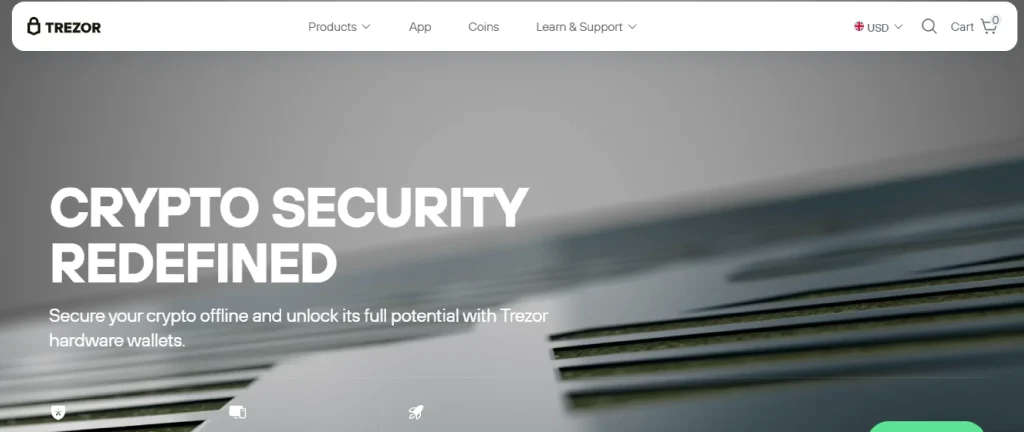
The Trezor Model T is a premium hardware wallet that offers strong security and compatibility for Monero users who want reliable cold storage. It can be paired with the official Monero GUI or CLI wallets, as well as third-party options such as the Feather Wallet, which allow users to securely manage their XMR holdings like the Safe 5. The Model T has some amazing features like a color touchscreen, USB-C connectivity, PIN and passphrase protection, and Trezor’s open-source security framework, which aligns with Monero’s privacy-focused approach.
While XMR management requires integration with external wallet software and cannot be purchased directly within Trezor Suite, the Model T provides offline protection and 1000+ cryptocurrencies and token support that make it an excellent choice for long-term Monero investors who prioritize security and transparency.
Cake Wallet
Cryptocurrencies: Monero, Bitcoin, Litecoin, and Haven
Wallet Type: Hot Wallet
Price: FREE
Link: cakewallet.com
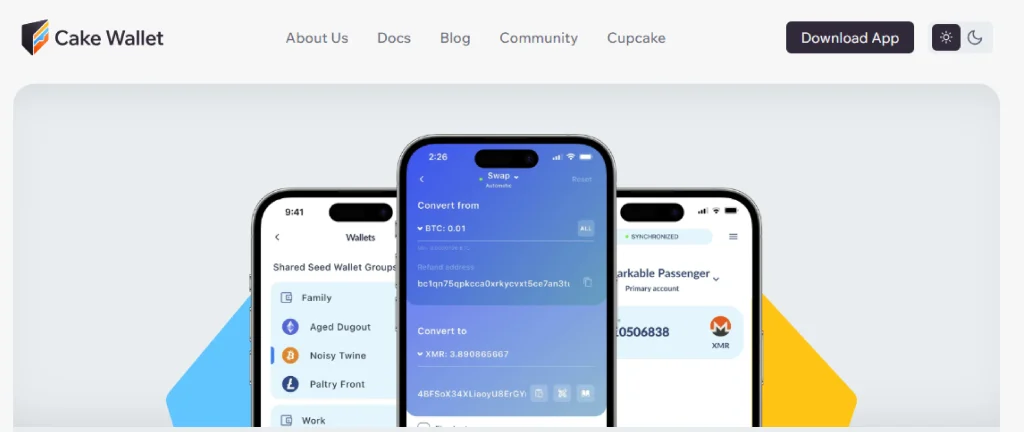
Cake wallet is an easy-to-navigate app for both Android and iOS. It allows you to expand your crypto portfolio through buying, selling, and keeping other cryptocurrencies as well. This wallet features client-side security with encryption and biometric authentication. It makes sure your funds and transaction data are secure and confidential.
Moreover, the seamless coin swapping feature in Cake Wallet allows you to swap between Monero and other cryptocurrencies directly within the app. If you are a beginner, then it is very useful for you to use it. Still, it offers advanced features like customizable transaction speeds and charges.
Monerujo Wallet
Cryptocurrencies: Monero
Wallet Type: Hot Wallet
Price: FREE
Link: www.monerujo.app
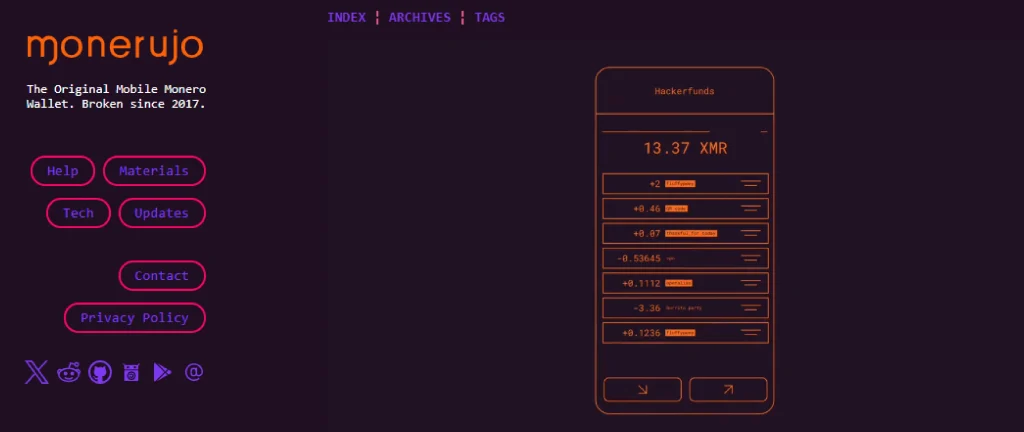
Monerujo Wallet is an Android-based Monero wallet, and it is popular among the XMR holders’ community. It is an open-source wallet that allows you to assess its code for bugs or malicious programming. It allows you to run your own node to interact with the Monero network, which is recommended to increase security and privacy. You can interact with the network with the remote open node.
Monerujo wallet also has a nice feature for switching between multiple Monero wallets. It has an XMR to service feature that lets you send your XMR tokens directly to the Bitcoin wallet address. bitcoin addresses then get the equal value in BTC tokens.
MyMonero Wallet
Cryptocurrencies: Monero
Wallet Type: Hot Wallet (Web)
Price: FREE
Link: mymonero.com

MyMonero is a lightweight alternative to the Monero GUI wallet. It was developed by a member of the core Monero development team. It is an open-source wallet that can be accessed from any device with an active internet connection. This wallet stores your private keys on a local device as opposed to a server, to boost the wallet’s security.
Also, you don’t need to download the entire blockchain to use the wallet. My Monero Wallet supports almost 20 fiat currencies, including USD and Euro. However, the lack of a multi-signature feature is the downside of this wallet. Means only the user signs off transactions and has only responsibility for coin security.
Ledger Nano X
Cryptocurrencies: 15,000+
Wallet Type: Cold Wallet (Hardware)
Price: $149
Link: www.ledger.com

Ledger is one of the safest and best options to store Monero offline that offers hardware-level security. Its features include sturdy designs, a big screen, durability, and two-button functionality. The Ledger Nano X keeps your private keys offline, which protects your Monero from online threats like malware and phishing attacks. Moreover, it supports Monero through the Ledger Live app (in combination with the Monero GUI or CLI wallet) that allows users to securely send, receive, and manage XMR while maintaining full control of their keys.
Guarda Wallet
Cryptocurrencies: 100+
Wallet Type: Hot Wallet
Price: FREE
Link: guarda.com

Gurada is a multi-cryptocurrency non-custodial hot wallet that you can access from any device with an active internet connection. It supports over 100 different cryptocurrencies, including Monero, fiat currencies, and major credit cards, trading on over 50 blockchains. It lets you send, receive, buy, swap, stake, and borrow digital assets. However, Guarda wallet does not charge any fees to download or use. But the in-app buying charges are expensive, which is at 5.5%.
Exodus Wallet
Cryptocurrencies: 100+
Wallet Type: Hot Wallet (software)
Price: FREE
Link: www.exodus.com

The Exodus wallet is a hot wallet that has recently included support for Monero. It supports web browsers, mobile, and desktop, and it has the most user-friendly interface. The built-in exchange feature lets you easily trade assets and enhance the efficiency of your transactions. The transactions and private keys are saved on your local device to offer security while keeping your control over reserves.
Edge Wallet
Cryptocurrencies: 100+
Wallet Type: Hot Wallet
Price: FREE
Link: www.edge.app

Edge is a hot wallet that supports Monero and many other cryptocurrencies. You can send, receive, and trade Monero and other cryptocurrencies within the app. It removes the requirement for using multiple applications or exchanges. It integrates encryption, which means your private keys are securely stored on your device. So, you have control over your assets and expand the security of your transactions. It is an easy-to-use wallet but lacks deep Monero customization options.
FAQs
Q: How secure is the Monero wallet?
A Monero wallet is made with security in mind and offers different layers of protection for privacy and the safety of your cryptocurrency. Here are some of the security features Monero wallets provide you:
- Stealth Addresses
- Ring Signature
- RingCT
- Cold Storage
- User control
Q: How can you securely store Monero?
Follow these tips to store Monero securely:
- Frequently back up your wallet data and prompt seed to avoid loss of access to your assets.
- Add a strong and unique password when creating your account on your wallet to protect against unauthorized access.
- Turn on 2FA for an additional security layer.
- Keep updating your wallet software to cover any security exposures.
Q: Why is Monero different?
Monero stands out from other cryptocurrencies because of its privacy. It uses advance cryptographic system to make sure all the transactions are private and untraceable. The security features help maintain the anonymity of the sender and the receiver. These features include Ring signatures, stealth addresses, and Ring Confidential Transactions (RingCT). All these technologies make it different and best cryptocurrency.